The exhibition «To Tell a Story» showcases Laurent Montaron’s photographs, films, sculptures and sound installations. It is conceived as a reflection on the way in which we engage with the world through narratives. It includes, among other works, a series of photographs taken in the birthplaces of ancient philosophy around the Mediterranean basin: nearly 2,500 years ago, the pre-Socratic philosophers were the first in the West to seek an objective description of reality, basing themselves on their observations rather than myths. Paradoxically, this search for truth has reached us only through quotations and reported texts, and it is therefore thanks to stories that we know the origin of our rational thought. Susan Sontag pointed out as long ago as 1983 in her television interview with John Berger broadcast in the UK on Channel 4’s program Voices «To Tell a Story» that the notion of narration refers to two diametrically opposed definitions: on the one hand, it is about reporting facts, while on the other, it is about creating fiction.The series of photography explores this ambivalent function of narrative in the form of an archaeology of representations that puts into perspective the omnipresence of images and storytelling today.At a time when our beliefs are more attached than ever to the stories with which we identify, and when, in the wake of social networks and algorithms devoted to the attention economy, various narratives coexist to the point of replacing the facts. The works invite us to consider what makes a shared experience of the world possible.
L’exposition «To Tell a Story» rassemble des photographies, des objets et des dispositifs sonores de Laurent Montaron. Elle est pensée comme une réflexion sur la manière dont nous nous engageons avec le monde à travers des récits. On y voit notamment une série de photographies prises dans les lieux qui ont vu naître la philosophie antique sur les pourtours du bassin méditerranéen : il y a près de 2500 ans, les philosophes présocratiques ont été les premiers en Occident à se mettre en quête d’une description objective de la réalité, se basant sur leurs observations plutôt que sur des mythes. Paradoxalement, cette recherche de vérité nous est parvenue seulement par le biais de citations et de textes rapportés, et c’est donc grâce à des histoires que l’on connaît l’origine de notre pensée rationnelle. Susan Sontag soulignait déjà en 1983 dans l’entretien télévisé «To Tell a Story» que la notion de narration renvoie à deux définitions diamétralement opposées : d’un côté, il s’agit de rapporter des faits, tandis que de l’autre, il s’agit de créer une fiction. L’exposition traverse cette fonction ambivalente du récit sous la forme d’une archéologie des représentations qui vient mettre en perspective l’omniprésence des images et de la mise en récit aujourd’hui. Dans un moment où nos croyances s’attachent
plus que jamais aux histoires auxquelles nous nous identifions, et où, dans le sillage des réseaux sociaux et des algorithmes dévolus à l’économie de l’attention, divers récits coexistent jusqu’à remplacer les faits; les œuvres de l’artiste nous invitent à penser ce qui rend possible une expérience partagée du monde.
To Tell a Story
1 juillet - 29 septembre 2024
10h00 - 19h30
École nationale supérieure de la photographie
30 avenue Victor Hugo Arles
Building, 2024
Photograph, pigment print on FineArt Baryta Hahnemühle paper
105 × 135 cm
The Building on La Canebière is a ten-storey structure located in the heart of Marseille, built in 1952 by architects Fernand Pouillon, René Egger, and Jean-Louis Sourdeau. Designed in the context of post-war reconstruction, it exemplifies the concept of an “urban building,” combining housing, retail spaces, offices, and parking within a single complex. Renovated in 2018, the building remains a testament to post-war modernist architecture and evokes the urban utopian ideals that informed its original conception.
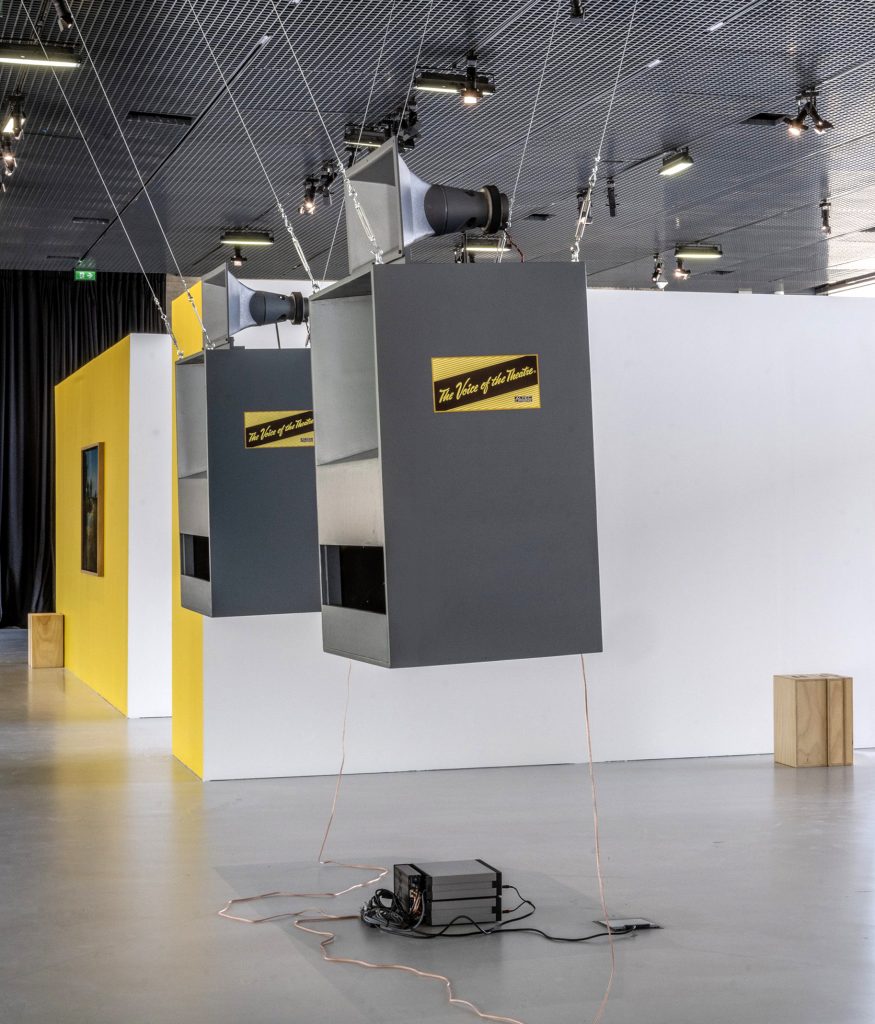
Voices of the Theatre, 2024
Pairs of Altec Lansing A7 speakers, each 76 x 60 x 160 cm, two frequency generators, amplifier.
Produced from the 1940s to the 1980s to provide sound for cinemas, the Altec Lansing A8 loudspeakers were designed to provide powerful, clear sound while remaining invisible, placed just behind the screens. Voice of the Theatre is an installation in which each loudspeaker emits a slightly different note from the other one generated live by a frequency oscillator. By synchronizing and then de-synchronizing, the sound from the speakers produces a beat that forms a looping pattern in the exhibition space